
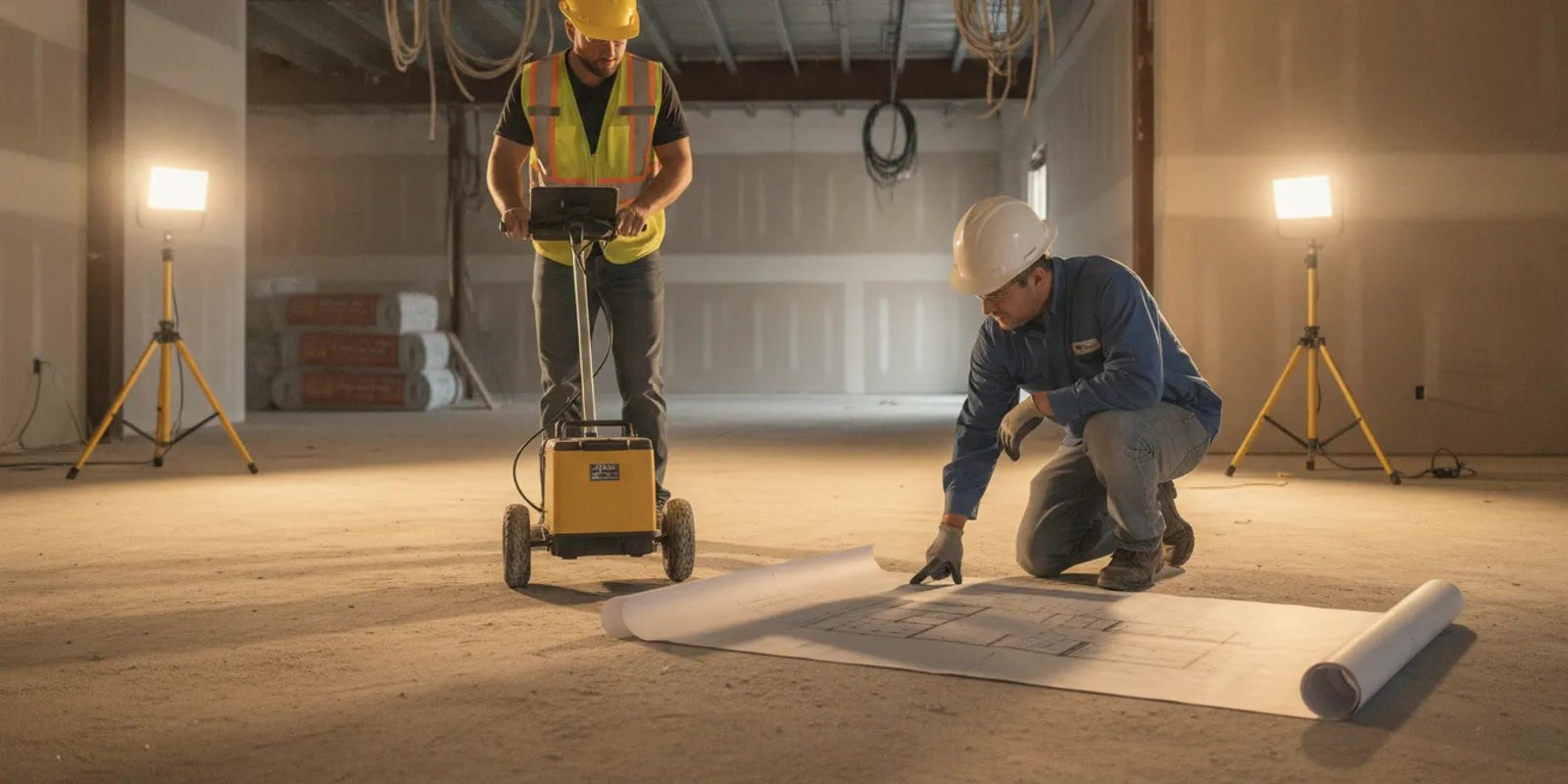
Choosing among concrete scanning companies is not just a matter of asking who has a scanner. For a Georgia project team, the useful questions are what the crew will investigate, how the work fits the planned opening or cut, and what information the team receives afterward. A clear scope helps you compare proposals and coordinate the next trade without treating a scan as a guarantee that a location is safe to cut.
What should a concrete scanning company clarify first?
Start with the decision your team needs to make. Are you planning a core hole for a pipe, a trench for a new service, or demolition near a structural element? The scanning area and planned work should be described together. A provider should understand the location, approximate dimensions, access, and why the information is needed.
Before requesting a proposal, gather the project basics:
Project address, building level, room, and the area to be scanned.
Surface type and known finish, coating, moisture, or access constraint.
Planned opening, cut, or demolition zone, with dimensions where available.
Drawings, previous scan records, and information about embedded services.
Schedule, site access rules, and the people who can make field decisions.
Those details let companies discuss whether the requested area and field conditions are workable. They also reduce the chance that a proposal assumes access or coverage the site cannot provide. If the drawings are preliminary, label them as such and identify which dimensions are confirmed. For a primer on the method, see our guide to concrete scanning with GPR.
How should you compare the proposed scope?
Look for a description of where scanning will occur, what the team intends to identify, and how boundaries will be established. If a proposal simply says “scan slab,” ask what that means in practice. Will the field crew cover the complete area around the proposed penetration, or only a marked point? Is the work intended to locate potential embedded objects in a limited zone, survey a broader area, or inform a particular drilling plan?
Coverage should reflect the decision at hand. A single small penetration and a long row of openings create different field tasks. Ask the company to state the number and location of scan areas, any dimensions or margins assumed, and what would count as a changed request. If a planned hole moves after the quote, the crew may need to reassess coverage rather than simply transfer an old mark.
For example, a mechanical contractor proposing one core hole should send the intended center point, approximate diameter, and nearby constraints. A general contractor planning several penetrations along a corridor should provide a marked plan showing all locations and sequence. The first request may suit a tightly defined survey; the second needs a scope that makes the repeated locations and coordination explicit. The purpose is not to prescribe a universal scan pattern, but to ensure the proposal actually covers the decision the team will make.
All Pro Demolition provides core drilling and GPR scanning; confirm the specific scope needed for your site when requesting a quote. Do not assume that a service-page description automatically defines the coverage or deliverables for a particular project.
What does the field process tell you?
Equipment alone does not explain how a scan will be performed. Ask how the crew will access the target area, whether surface preparation is needed, and whether obstructions or finishes could affect coverage. Wet or freshly poured concrete can be unfavorable for GPR measurements, as noted in this GPR applications manual. If the slab is newly placed or conditions are unusual, describe them before the visit and ask how they affect the proposed plan.
Also establish who will mark the area and who has authority to approve a change in location. A scan provides information for planning; it is not permission to proceed automatically. The project team still needs to evaluate drawings, site conditions, trade requirements, and applicable safety procedures before drilling, cutting, or demolition begins.
Ask how the provider handles an unexpected result. If the crew identifies a possible conflict near the proposed opening, who is contacted? Can the project representative review an alternate location while the crew is on site, or should the team stop and obtain a design review first? Set that communication path in advance. The right response depends on the project's design and the responsible professionals; a field conversation should not silently change structural intent.
What should the deliverable include?
Ask what you will receive and when. Depending on the agreed scope, the useful handoff may include field markings, a drawing or marked-up plan, notes about the surveyed area, and an explanation of limitations. Be specific about whether your crew needs information at the slab, in a report, or both. If another contractor will make the cut or hole, confirm that the handoff is understandable to that crew.
Clarify how the provider describes uncertainty. Scanning results should not be treated as a complete inventory of everything inside concrete or as a guarantee that a selected path has no risk. Ask what the method can and cannot establish under conditions at your site. The next crew needs to know which area was covered, how marks correspond to the plan, and what limitations apply, not just receive a verbal “clear.”
When the result is marked on a surface, identify who will preserve the markings until work begins. A busy jobsite can erase or obscure them. Photographing the marked area and linking the image to a room or grid reference can help the project team maintain context, if that fits its documentation process. If marks are disturbed, the crew should not guess their original position; confirm with the scanning provider or project lead.
How do concrete scanning companies differ from one another?
Compare the working process rather than relying on broad claims. One provider may propose a narrowly defined area around one penetration; another may include a wider survey or a different reporting handoff. Neither is automatically better. The right choice depends on the project decision and what the crew can access.
Scope and exclusions
Check the area, number of locations, access assumptions, and excluded surfaces. Confirm whether return visits or changed locations require a revised scope. Ask the company to explain terms that are unclear, and make sure the proposal identifies what information the client must supply.
Field coordination
Find out how the scan fits the site schedule and who needs to be present. On an active job, coordination with the general contractor, building representative, and trades can matter as much as the scan itself. The scanning visit may need to precede a drilling or cutting crew's mobilization, so align the sequence early.
Reporting and communication
Compare the format of the result and its explanation. Ask whether marks will be visible to the next crew, whether a plan or image is included, and how limitations are communicated. A useful handoff is one the project team can act on without guessing what area was covered.
Related work and accountability
If scanning is part of a larger concrete operation, ask who coordinates changes when field information affects the planned work. Some projects also require separate concrete cutting services, core drilling, or demolition. Confirm which activities are included, who performs them, and what must be approved before work proceeds. A single conversation about related work can make sequencing clearer, but the scope should still name each task rather than imply it is included.
How do access and surface conditions affect planning?
Scanning needs access to the relevant surface. Stored materials, equipment, fixed fixtures, wall edges, or restricted rooms may limit the survey area. Coatings and uneven surfaces can also affect how a crew works. Tell the provider what will be in place during the visit rather than assuming the field team can move items or work around every obstruction.
For occupied commercial spaces, agree on access windows and rules for moving through the area. Confirm whether the work zone must be cleared in advance and who is responsible for clearing it. If the planned opening is close to a wall, column, joint, or existing penetration, show that relationship on a drawing or during a walkthrough. A photo with a visible reference point can be useful, but it should supplement, not replace, clear location information.
Consider a renovation where the target room is accessible only before tenants arrive. If equipment or stored materials block part of the slab during that window, the provider should know before scheduling. The project manager can then decide whether to clear the area, change the sequence, or ask for a revised scope. Likewise, a room with a newly placed slab deserves an early discussion about condition and timing instead of an assumption that a visit can proceed as usual.
For broader project preparation, our Georgia concrete cutting planning guide covers scope and coordination considerations for cutting work. If the project includes an opening through a structural element, refer the design question to the responsible project professional; a scan does not replace structural review.
How should you compare proposals fairly?
Before comparing totals, make sure the proposals describe the same job. A short quote may look less expensive because it covers fewer locations, assumes unobstructed access, or omits a drawing or report. Another proposal may include a broader survey or a different handoff. Ask each company to explain its assumptions in plain language, then note any unresolved difference.
Use this sequence to normalize the comparison:
List every proposed opening, cut, or area on one drawing or location schedule.
Match each proposal's coverage to that list and flag omissions or alternate assumptions.
Compare the promised field markings, notes, plans, and timing of the deliverable.
Identify access, surface, and schedule conditions that each company expects the site to meet.
Record what happens if the project changes locations or requests additional coverage.
Ask who receives results and who can answer a question before the next trade starts.
For a simple example, suppose two proposals address four planned penetrations. One explicitly names all four and describes the handoff; the other says “scan slab” without identifying locations. The second is not automatically inadequate, but its scope is not yet comparable. Request clarification before choosing based on the total. Once both proposals address the same locations and deliverables, the team can weigh schedule, access, communication, and price with fewer unknowns.
Keep the written answers with the project documents. If the scope changes after award, capture the change and confirm its effect on field coverage and timing before the crew arrives. This avoids relying on a site conversation that later participants never heard.
How should scanning connect to drilling, cutting, or demolition?
Set the order of operations before crews arrive. The team planning a penetration should provide the proposed position and dimensions, while the scanning provider should know what work is planned. After the scan, the responsible parties need a clear handoff: where findings were marked, what area was covered, and whether any issue needs a field decision.
Define the planned work and mark intended locations on a drawing or surface.
Share drawings, access details, and known site information with the scanning company.
Agree on coverage, deliverables, timing, and the person who can resolve questions.
Review results with the drilling, cutting, or demolition team before work starts.
Pause and seek the appropriate project review if conditions or markings do not match the plan.
For a core-hole project, the concrete core drilling project guide explains the method and planning questions to raise. For another perspective on matching drilling needs to a project, see how concrete drilling services fit different requirements. If concrete cutting is also part of the scope, distinguish scan work from cutting work in the schedule and quote so each responsible crew knows when it acts.
What should you ask before hiring a company?
Use a short set of questions to make proposals easier to compare:
What exact areas and locations are included?
What information should we provide before the field visit?
What surface or access conditions could limit the work?
What method and deliverables are proposed for this project?
How will results and limitations be communicated to the next trade?
Who should attend the site visit or review the handoff?
What is excluded, and how are changed locations handled?
How does the schedule coordinate with drilling, cutting, or demolition?
Ask follow-up questions when an answer is vague. “We mark the slab” can mean very different things unless the proposal states which locations will be marked and how the field team will identify them. “We send a report” is clearer when it names the format, what it shows, and when it will arrive. The aim is not to demand one standard document from every provider; it is to understand exactly what your team will receive.
You can also ask who the point of contact is on the visit day and what happens if that person is unavailable. For a multi-trade project, identify one person who can relay questions to the decision-maker rather than leaving the scan crew to resolve design conflicts independently. This small planning step can keep an unexpected finding from becoming an untracked field change.
What information should you send for a Georgia project quote?
Give the company enough detail to understand the field request, but do not wait for perfect drawings if the plan is still developing. Send the address, a short project description, target locations, approximate dimensions, access constraints, desired timing, and relevant plans or photos. Note whether the work is for an occupied building, a renovation, or a new construction area.
When available, include the floor or room names used on site, the planned trade activity, and any known restrictions on work hours. Separate confirmed facts from assumptions: for instance, label a proposed hole position as preliminary if the layout is still under review. Mention who can answer questions about plans and who is authorized to approve any location change. That lets the provider discuss a realistic scope without making decisions on behalf of the design team.
All Pro Demolition serves demolition and concrete-related projects in its Atlanta-area service market. If you need to discuss scanning alongside drilling or cutting, use the contact page to share the project details. You can also review the about page for general company information.
What does a practical project example look like?
Imagine a tenant improvement that needs several new service penetrations through an existing floor. The mechanical layout identifies approximate locations, but final routing still depends on field coordination. The project manager can first send the drawing and mark which openings are fixed versus tentative. The scanning company can then quote a defined set of areas and state what access and surface conditions it expects.
Before the visit, the site team clears the agreed work zone and makes sure the scanning crew can reach each location. The project representative is available to identify the locations and explain any nearby constraints. After scanning, the team reviews the marks and notes against the drawing with the drilling contractor. If a location appears to conflict with the plan or the field marks are unclear, the team stops to clarify rather than moving the hole informally.
Now consider a different case: a contractor wants a single opening but the intended spot is close to a column and the structural details are incomplete. In that case, a scanning proposal can define the requested survey, but the scan itself cannot decide whether the opening is structurally acceptable. The project team should obtain the necessary design direction and then make sure the location and scope sent to the field crew match that decision. These examples show why good provider selection is partly about communication and limits, not only equipment.
Contact us to discuss your project
Frequently asked questions about concrete scanning companies
Does a concrete scan guarantee a location is safe to drill?
No. Scanning provides information to support planning, but it does not guarantee that a location is free of every embedded item or eliminate all project risks. The responsible project team must review findings and site conditions before authorizing work.
Should scanning happen before core drilling?
When a project needs information about embedded conditions before making a hole, scanning can be planned before drilling. Share intended hole locations and dimensions with the scanning provider, then ensure the drilling team understands the results and limitations before starting.
What should I send when requesting a scan?
Send the project location, area and planned work, drawings or marked-up plans if available, surface and access details, schedule needs, and a contact who can answer site questions. Clear information helps the provider propose a scope that matches the job.
Can one contractor coordinate scanning and concrete work?
Some providers offer related services, but confirm exactly which tasks are included and who is responsible for each part. All Pro Demolition offers concrete cutting, core drilling, and GPR scanning capabilities; contact the team to discuss the project scope.
How can your team make the handoff useful?
Choose a concrete scanning company by matching its scope and communication to the decision your project needs to make. Define the locations, provide site details, agree on the deliverable, and review the findings with the trade that will work next. That process gives your Georgia team a clearer basis for coordinating the work while keeping the final decision with the responsible project professionals.
