
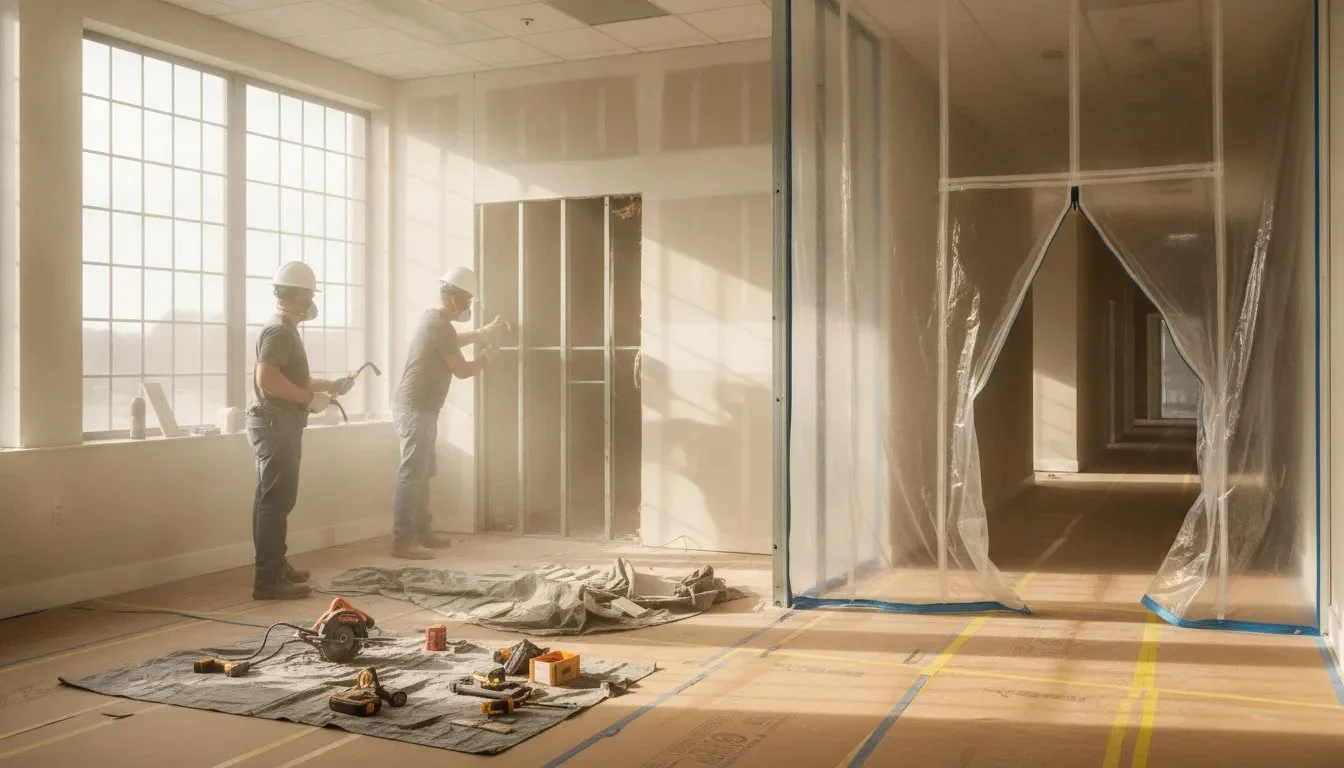
Interior demolition contractors should be judged by the protection plan in the proposal, not by the lowest lump sum. On a Georgia renovation, the building stays. Ceilings, floors, partitions, and specialty items come out, and everything the drawings keep has to survive the work. A bid that names the barriers, floor protection, and handback condition is easier to award than a bid that only names a price.
Request an interior demolition quote
All Pro Demolition performs ceiling, flooring, partition, and specialty interior demolition across Georgia. Crews bring more than 10 years of experience and a stated focus on close attention to detail. Use the checks below before you award.
If you still need the broader hiring screen for license, insurance, and schedule fit, start with how to choose demolition contractors in Georgia. Then come back to the protection details.
What interior demolition contractors should put in writing
A useful proposal splits the work into the same categories the site will actually see. Ask for separate lines for ceilings, flooring, partitions, and specialty items. A single line that says "interior demo" hides whether carpet adhesive, ceiling grid, millwork, or a feature wall is included.
Each line should say what is removed, what stays, and who protects the stay items. Ceiling work might mean acoustic tile and grid only, or it might include drywall ceilings. Flooring might stop at the finish, or it might include thinset and adhesive. Partition work should say non-load-bearing only unless a structural note says otherwise. Specialty items, such as built-ins, fixtures, or a custom feature, need their own note so they are not treated like ordinary drywall.
The same proposal should name the handback. "Broom clean" and "ready for the next trade" are not the same promise. Ask whether the crew removes fasteners, adhesive residue, and loose debris from retained slabs and walls. Ask whether protection is pulled at the end or left for the general contractor. Those sentences are the detail you can enforce later.
If the project is a full commercial strip-out rather than a selective interior scope, read the sequence in the Georgia commercial strip-out guide. This page stays on the bid language, not the day-by-day removal order.
How to score finish protection before you award
Detail shows up where the crew will touch something that must remain. Walk the proposal against the drawings and mark every retained finish. Then ask the bidder to answer five protection items in writing.
Dust barriers: where they go, how they seal to the slab and the deck, and whether a zipper door is included.
Floor protection: what covers retained flooring on the path from the work area to the freight elevator or exit.
Wall and opening protection: how finished corridors, elevator cabs, and door frames are covered.
Fixture protection: which lights, devices, casework, and equipment stay in place and get covered.
Daily cleanup: who sweeps, who bags, and whether debris leaves the floor the same day.
A strong answer names materials and locations. "We will be careful" is not a protection plan. Poly sheeting at the corridor door, ram board on the retained lobby floor, and padded elevator pads are. If two bids differ by those lines, the cheaper bid may simply have left the protection out.
Occupied or partly occupied buildings need one more line: how the work area is separated from people who are not on the crew. NIOSH has documented indoor air problems when renovation dust is not controlled and occupants are not told what the work will produce. You do not need a research paper in the bid. You do need a sentence that says the occupied side stays outside the work zone.
All Pro's interior scope is built around that kind of selective work: ceilings, floors, partitions, and specialty removal while the rest of the building remains. The interior demolition service page is the right place to match that scope before you ask for a number.
Which protection lines separate a careful bid
Compare bidders on the same protection items. If a line is missing, ask for it before you treat the prices as equal. The notes below are evaluation checks, not a crew method.
Barriers and negative-pressure intent
Look for a barrier at every opening between the work area and a finished or occupied space. The bid should say the barrier is sealed, not just hung. On a sensitive interior, also ask whether air from the work area will be kept from blowing into the occupied side. The full dust-control discussion lives in managing dust and safety in commercial interior demolition. Here, the only question is whether the proposal owns that control.
Floors, corridors, and vertical transport
Retained floors fail on the haul path more often than inside the room being stripped. Ask which product covers the path, who repairs it if it tears, and whether the elevator or stair used for debris is protected. A bid that removes debris through an unprotected lobby is a damage claim waiting on a cart wheel.
Retained structure and openings
Interior demolition is not structural demolition. The proposal should say load-bearing walls, slabs, and frames stay unless the drawings say otherwise. OSHA's demolition rule, 29 CFR 1926.850, requires a competent person to survey the structure before work starts. The survey includes any adjacent structure where workers may be exposed. The employer must keep written evidence of that survey. Ask who performs it and where the writing will live in the job file.
The same rule covers openings. Floor holes that are not used as material drops must be covered and secured. The cover has to hold the load and stay fixed. Wall openings with a fall hazard must be guarded to about 42 inches. If the bid is silent on covers and guards, the bidder has not priced day-one protection. For method choices on true structural work, use the structural demolition guide instead of stretching an interior bid.
Utilities that must stay live
OSHA also requires service lines to be shut off, capped, or otherwise controlled before demolition. That includes electric, gas, water, steam, and sewer. The utility company involved must be notified in advance. If a line must stay live, it has to be relocated as needed and protected. A careful interior bid says which systems are dead and which stay active. It also says how live lines inside the work area are marked. Guessing at a pipe during partition removal can turn a selective job into a building outage.
How detail shows up in ceilings, floors, and partitions
Protection language should change with the assembly being removed. Use the drawing tags, not a generic demo allowance.
Ceilings
Ask whether the grid stays, whether tile is bagged or bulk-loaded, and how lights that remain are supported once the tile is gone. Above-ceiling dust falls onto retained floors if the crew opens the plenum without a barrier below. A detailed bid names the floors that get covered before the first tile comes down.
Floors
Finish removal and substrate repair are different scopes. Carpet, tile, hardwood, and adhesive each leave a different surface for the next trade. Ask the bidder to state the surface they will hand back: bare slab, adhesive-scraped slab, or finish left in place outside the work line. If a concrete cut or core is required to open a slab for a new utility, that is a separate scope. GPR concrete scanning before a cut should be named before anyone saws a retained slab. All Pro can pair that scan and the core with the interior removal so the opening is not a surprise change order.
Partitions and specialty items
Non-load-bearing partitions still hide wiring, piping, and finishes on the far side. The bid should say the crew stops at the retained wall and protects the opposite finish. Specialty items need a keep-or-remove mark. A feature wall, a reception desk, or a medical headwall should not ride inside a "misc. demo" line.
When the interior scope is only one room or one assembly, the selective demolition comparison helps you decide whether a full strip is even the right ask. Do not reuse that page's hiring list here. Use it only to confirm the scope type before you score protection.
What to require at handback
Detail is proven when the crew leaves. Put the handback test in the award, not in a punch argument after the fact.
Walk the retain line with the drawings and confirm every keep item is still in place and uncovered only where the next trade needs it.
Check barriers, floor protection, and opening covers that must stay up for later work, and list anything the demo crew will remove.
Look at the haul path, elevator, and exit for scrapes, tears, and dust on the occupied side of the barrier.
Confirm debris, fasteners, and leftover protection scrap are off the slab the next trade will use.
Collect the engineering-survey note, utility status, and any scan or core records before you release the crew.
If the slab needs new concrete after a removal or a core, say so in the same handback note. Pour-back after demolition is a follow-on scope, not a free extra inside a strip price. Naming it now keeps the interior contractor and the concrete scope from pointing at each other.
Noise can be part of the same handback conversation on a tight site. It is not a protection line by itself. If the building or the city will limit hours or levels, use pre-demolition noise studies in Georgia as the separate planning step.
A short award test for Georgia interior work
You can award faster when every bidder answers the same page. Ask for these items with the price.
Scope split: ceilings, flooring, partitions, and specialty items, each marked remove or retain.
Protection: dust barrier locations, floor protection on the haul path, and covering for finished walls, doors, and elevators.
Structure and openings: confirmation that retained structure stays, plus covers and guards for new openings.
Utilities: what is off, what stays live, and how live lines are protected.
Handback: the surface left behind, the cleanup standard, and which protection remains for the next trade.
Adjacent work: whether scanning, cutting, cores, or pour-back are included or excluded.
Score missing lines as exclusions, not as savings. Then compare price. That is the practical difference between interior demolition contractors who price the care of the building and bidders who price only the debris.
All Pro Demolition is a Georgia contractor for interior and exterior demolition, core drilling, and GPR scanning, so connected openings do not have to be handed to a second crew by default. Heavy equipment, when a scope needs it, is run by licensed operators. The company is family owned, led by Omar Maldonado, and quotes each job from the drawings rather than from a posted rate card.
Send the drawings and a note on what must stay. Contact All Pro Demolition or call (470) 345-2816 to price the protection with the removal.
Frequently Asked Questions
What should I compare when I review interior demolition contractors?
Compare the written scope and the protection lines, not the lump sum alone. Look for ceilings, floors, partitions, specialty items, dust barriers, floor protection, opening covers, utility status, and a named handback condition.
Does a low interior demolition bid usually include finish protection?
Do not assume it does. If barriers, haul-path floor protection, and elevator or corridor covering are missing, ask for them in writing before you treat that price as comparable.
Who is responsible for the demolition engineering survey?
OSHA requires the employer doing the demolition to have a competent person survey the structure before employees start, and to keep written evidence of that survey. Ask the bidder who signs it and where it will be filed.
How is interior demolition different from structural demolition?
Interior demolition removes non-structural ceilings, floors, partitions, and specialty items while the building remains. Structural demolition changes beams, load-bearing walls, slabs, or the building itself and needs its own method review.
Can one Georgia contractor handle demo, scanning, and a core?
Yes. All Pro Demolition can quote interior demolition together with GPR scanning and core drilling when the drawings call for an opening in concrete. Ask for those items as included or excluded so the handoff is clear.
