
How to Choose Demolition Contractors in Georgia
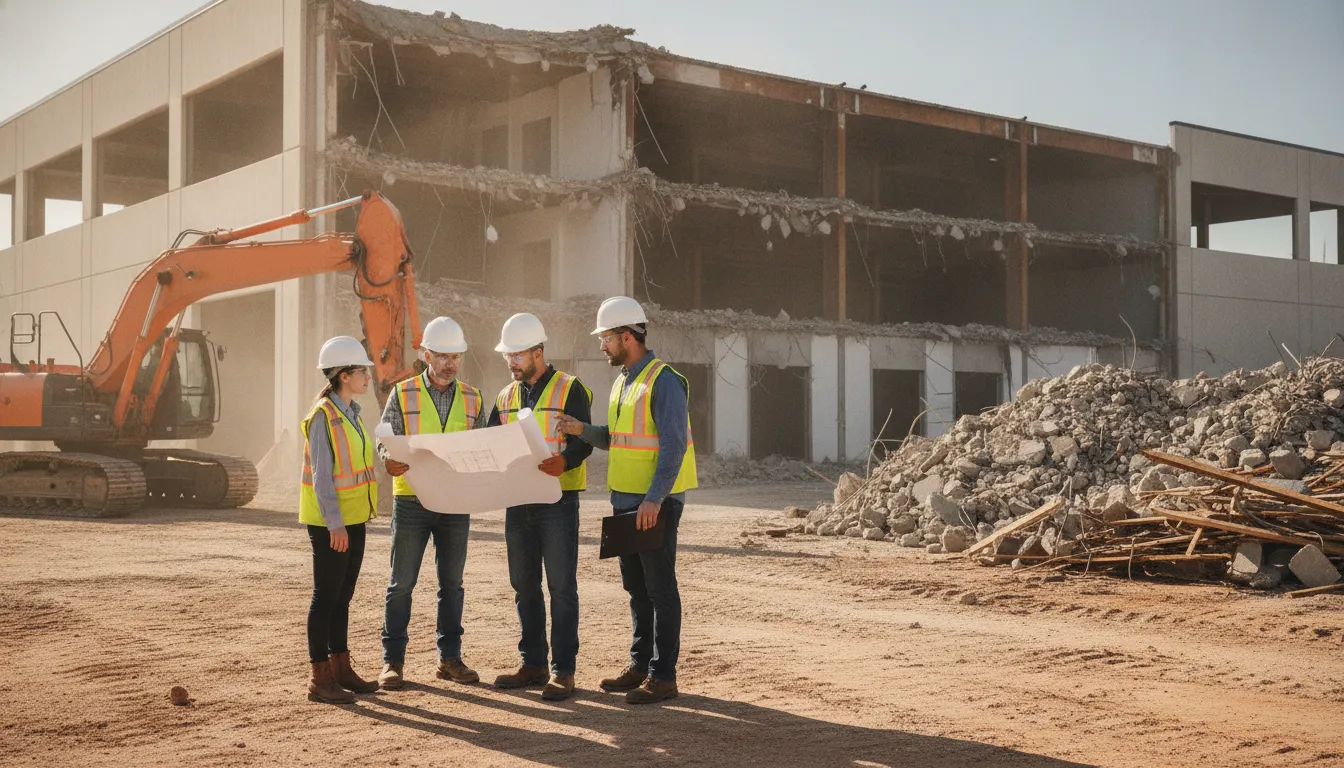
Choosing a demolition contractor in Georgia is not simply a matter of finding a crew with the right equipment. The provider must understand your scope, protect surrounding operations, coordinate with the project schedule, and communicate clearly about what happens before, during, and after removal work.
Request a project review for your Georgia demolition project.
The right demolition contractors match their capabilities to the work. That may mean interior removals, exterior demolition, surgical cuts, specialty work, or a full structure wrecked. Look for documented planning, qualified operators, realistic scope assumptions, debris and utility coordination, and one accountable point of contact.
That evaluation starts by defining what the contractor will actually handle. A clear service boundary helps you identify the equipment, technical support, safety planning, and coordination your project requires before you compare proposals.
What Do Demolition Contractors Actually Handle?
Demolition is broader than bringing down an entire building. OSHA defines it as "the dismantling, razing, destroying or wrecking of any building or structure or any part thereof." That last phrase matters on renovation and construction sites. The work may involve removing a few interior assemblies, opening a controlled path through an existing structure, or clearing a complete site for the next phase.
For buyers, the right question is not simply whether a contractor performs demolition. It is which kind of removal the project requires, what must remain protected, and how the work will connect to the rest of the schedule.
Interior demolition
Interior work can include the removal of ceilings, flooring, partitions, and other nonessential or outdated components. It may prepare a tenant space for a new layout, clear a facility for renovation, or expose the areas that another trade needs to access. A useful scope should identify each assembly being removed, the areas that must remain intact, dust and debris controls, and the condition expected at turnover.
Interior demolition is often selective rather than total. If the project requires a clearer comparison of what stays and what goes, see this guide to choosing between selective and total demolition contractors.
Exterior, surgical, and specialty work
Exterior demolition may involve walls or other portions of an existing structure. Surgical demolition takes a more controlled approach when removal must be limited around adjacent construction, occupied areas, or components intended to remain. The scope should describe the exact boundaries, access conditions, protection requirements, and handoffs to the next trade instead of relying on a broad phrase such as "demo as needed."
Specialty work can require a different method, sequence, or level of coordination than routine interior removal. All Pro Demolition describes its services as covering interior and exterior demolition, including ceilings, flooring, partitions, exterior walls, surgical, specialty, and wrecking work. The company also integrates traditional demolition with core drilling and GPR scanning, which can reduce coordination complexity when precision openings or subsurface information are part of the plan.
Full wrecking and site-clearing scope
Full wrecking work is the broadest category, involving the removal of a complete building or structure rather than selected components. It still needs a defined scope. Buyers should expect the discussion to cover the structure, work limits, equipment access, debris handling, utilities, and the condition of the site after removal. OSHA notes that demolition planning should address an engineering survey by a competent person before work begins, along with hazards such as hidden materials, altered design, and unknown structural strengths. Those factors affect how a contractor evaluates the work, not just how quickly equipment can operate.
A well-written scope makes the expected result visible: what is removed, what is protected, what supporting services are included, and where the demolition contractor's responsibility ends. That clarity helps general contractors, developers, facility managers, and property owners coordinate the next phase without relying on assumptions.
How Should Georgia Buyers Match Demolition Contractors to Project Scope?
The right contractor depends on what must be removed, what must remain, and what the next trade needs to do after demolition. A crew experienced in whole-structure wrecking may not be the best fit for a tenant improvement with occupied areas, sensitive finishes, or tight limits around structural elements. Before requesting a proposal, define the work by type and by risk.
Interior demolition
Interior work can include ceilings, flooring, partitions, fixtures, and other selected components. Ask whether the contractor regularly works inside active commercial spaces and can control dust, debris movement, access, and protection of retained systems. The scope should identify exactly what is being removed and what stays in place. If the project is a renovation, compare the proposal with your drawings and walk the site together so assumptions about walls, finishes, MEP components, and disposal do not become change orders.
Exterior, surgical, and specialty work
Exterior demolition may involve walls, additions, site elements, or portions of a structure that affect weather protection and adjacent operations. Surgical demolition calls for a more controlled approach around structural members, utilities, occupied areas, or finishes that must be preserved. Specialty work may also involve unusual materials, restricted access, or historic construction methods. For a historic property, look for a contractor that understands the need to remove targeted components without treating the entire building like a conventional teardown. This guide to specialty demolition contractors for historical sites provides additional planning context.
Georgia buyers should also consider local experience. The EPA notes that familiarity with local conditions, building practices, commonly used materials, and local requirements can matter when selecting a contractor. That does not replace project-specific planning, but it is a useful question to ask when comparing teams for work in different parts of the state. If concrete access or penetrations are part of the scope, this Georgia core drilling field guide can help frame the coordination questions.
Wrecking and complete removal
Wrecking work has a different equipment, access, sequencing, and debris-management profile from selective removal. Confirm that the bidder has handled the structure type and can explain how the site will be cleared, how debris will move, and how the work will coordinate with utilities and the next phase. OSHA defines demolition broadly as dismantling, razing, destroying, or wrecking a building or part of one. So the label alone does not tell you whether a contractor fits your actual scope. OSHA's demolition guidance reinforces why the pre-work plan must reflect the specific structure and conditions.
Finally, ask whether adjacent services can be coordinated through the same accountable team. Core drilling or GPR coordination may be useful when openings, concrete cutting, or subsurface information are needed alongside demolition. Keeping those services aligned can reduce handoffs, duplicated site visits, and schedule confusion. All Pro Demolition states that it integrates traditional demolition with core drilling and GPR scanning for this reason. The best match is not the broadest claim; it is a contractor that can explain the equipment, experience, sequencing, and boundaries for your specific Georgia project.
What Qualifications and Safety Questions Should You Ask?
A demolition contractor's qualifications should be visible in the way the team plans, communicates, and documents the work. A polished proposal is not enough. Ask how the contractor will understand the existing structure, protect adjacent areas, coordinate utilities, and respond if site conditions differ from the assumptions.
Ask how the structure and hazards will be assessed
Before demolition begins, OSHA says an engineering survey should be completed by a competent person. The survey helps identify structural conditions that could affect the sequence and method of removal. Ask who will conduct it, when it will be completed, and how its findings will be reflected in the work plan. You can review OSHA's demolition guidance at osha.gov/demolition.
That discussion should address more than visible walls and finishes. OSHA identifies hidden materials, changes from the original design, and unknown strengths or weaknesses in construction materials as demolition hazards. Ask what the team does when drawings are incomplete, alterations are suspected, or concealed conditions may change the scope. A qualified contractor should be able to explain what information is needed before equipment and labor are committed.
Ask for a practical safety and emergency plan
Safety communication should be specific to the site, not limited to a generic statement about working safely. Ask how the contractor will identify health hazards, establish work-zone controls, protect workers and other trades, and communicate daily changes. OSHA's planning guidance also calls for locating, securing, or relocating nearby utilities, along with fire prevention and evacuation planning. Ask where those items appear in the project documentation and who owns each coordination step.
It is also reasonable to ask how supervisors discuss hazards with the crew. NIOSH describes Toolbox Talks as focused discussions about job hazards, solutions, and best practices for construction workers. A contractor that can show how those conversations fit into daily operations is giving you a clearer view of its safety process. Documentation may include a site-specific plan, pre-task briefings, utility confirmations, emergency contacts, and records of changes or incidents.
Verify experience, oversight, and operator qualifications
EPA recommends checking past performance with relevant pollution-control, worker-safety, and licensing or accrediting agencies when applicable to the work. EPA also notes that local experience can matter because local conditions, building practices, materials, and requirements vary. Read the agency's contractor selection guidance at epa.gov, then ask for project references that resemble yours in structure, access, and complexity.
For environmental concerns or specialized remediation, ask who performs the assessment and who performs the remediation. EPA cautions against conflicts where the assessment firm is connected to the company performing the abatement. Confirm the relevant qualifications for the actual work rather than assuming a general demolition credential covers every specialty.
All Pro Demolition states that its heavy machinery operators are licensed. Ask any contractor which team members will operate equipment on your project and what qualifications, supervision, and documentation apply. These questions help distinguish a contractor prepared to manage real site conditions from one relying on a broad capability list.
How Do Debris, Utilities, and Scheduling Affect the Plan?
A demolition plan is also a logistics plan. It should explain how people, equipment, materials, and information will move through the site without disrupting the next phase of work. For Georgia general contractors, developers, and facility managers, that level of detail can be as important as the removal method itself.
Define debris handling and haul-off
Ask the demolition contractor to identify what will be removed, where debris will be staged, how it will leave the property, and who is responsible for disposal. Haul-off is a scope question, not an assumption that every proposal includes the same level of cleanup. A clear plan should distinguish between loading, transportation, disposal, recycling or salvage requirements, and final sweeping or site preparation.
Those details affect access, equipment selection, labor, and the schedule. On a constrained commercial site, a contractor may need a designated staging area, delivery windows, protected travel paths, or coordinated dumpster service. If the proposal excludes certain materials or disposal activities, the exclusion should be visible before work begins. This is one reason a project-specific quote should clarify scope, structure type, debris disposal, labor, and equipment requirements. For a practical discussion of material recovery and disposal planning, review this guide to concrete recycling in demolition.
Coordinate utilities and adjacent work
Utility coordination belongs in the preconstruction conversation. OSHA's demolition guidance includes locating, securing, or relocating nearby utilities as part of planning, along with preparing a fire prevention and evacuation plan. See the OSHA demolition planning guidance for the full safety framework.
In practice, the plan should identify known electrical, gas, water, sewer, fire protection, and communication services, then state who confirms their status before the affected area is opened. It should also account for adjacent tenants, occupied areas, active production, neighboring structures, and other trades. Protection may include barriers, dust and debris controls, temporary weather protection, monitoring, or restricted work zones. The right measures depend on the site and should be documented rather than left to informal handoffs.
Build schedule handoffs into the scope
A dependable schedule shows more than a start date and a finish date. It identifies prerequisites, daily access requirements, inspection or clearance points, debris removal windows, and the condition in which the area will be turned over. It should also show when the demolition team coordinates with the superintendent, utility providers, environmental specialists, and follow-on trades.
Single-source accountability can reduce friction when traditional demolition must be coordinated with technical work. All Pro Demolition combines demolition with precision core drilling and GPR scanning, which can help keep related coordination with one subcontractor when the project requires those services. Before selecting a contractor, ask who owns each handoff, how schedule changes are communicated, and what documentation confirms an area is ready for the next trade.
How Can You Compare Demolition Quotes Without Comparing Only Price?
A demolition quote is useful only when you can see what the contractor is actually agreeing to deliver. Two bids may differ because they use different assumptions about the work, access, equipment, disposal, or schedule. A lower figure may leave important responsibilities outside the stated scope, while a higher figure may include coordination that another bidder has not addressed. Compare the work plan behind each quote, not just the number at the bottom.
Start with the scope and site assumptions
Ask each of the demolition contractors to identify the exact areas and materials included. The quote should make clear whether the work covers interior finishes, partitions, structural elements, exterior components, or a complete teardown. It should also state the structure type, access points, working hours, protection for adjacent areas, and any assumptions about utilities or existing conditions.
Scope language matters because demolition is not one uniform activity. Selective removal inside an occupied or partially renovated building creates different planning needs from open-site wrecking. If your project involves a narrow opening, concrete penetration, or uncertain subsurface condition, ask whether core drilling or GPR scanning is included, excluded, or assigned to another trade. Clear boundaries reduce the chance that a technical need appears later as an unexpected change.
| Quote area | What to compare |
|---|---|
| Scope | Areas, materials, structure type, protection, and exclusions. |
| Resources | Labor, equipment, operators, access, and work hours. |
| Logistics | Staging, loading, haul-off, disposal, cleanup, and handoff condition. |
| Coordination | Utilities, schedule milestones, change orders, and responsible contacts. |
Review labor, equipment, and debris handling
Look for a practical description of the labor and equipment required to perform the work. A quote should identify the expected machinery, operators, hand-demolition labor, loading method, and any access limitations that could affect production. It should also explain how debris will be sorted, loaded, transported, and disposed of. Confirm whether haul-off, disposal coordination, cleanup, and final site condition are included. If these items are vague, ask for them in writing before selecting a contractor.
Compare exclusions, schedule, and change-order rules
Read the exclusions as carefully as the inclusions. Ask who is responsible for permits, utility locating, hazardous-material assessment or abatement, temporary protection, traffic control, and restoring areas affected by the work. Not every contractor performs every specialty task, but the quote should identify the boundary and the handoff.
- Confirm the areas, materials, and structure type included.
- Compare equipment, labor, access, protection, and disposal assumptions.
- Identify exclusions, prerequisites, utility responsibilities, and handoffs.
- Match the schedule to site access and follow-on trade needs.
- Document how changed conditions and added work will be approved.
Finally, compare schedule assumptions and change-order procedures. Ask what site conditions could alter the plan, how those conditions will be documented, who must approve added work, and how schedule effects will be communicated. A clear process protects both sides when drawings, access, or existing construction do not match expectations. The strongest quote is the one that lets you compare scope, accountability, and execution with confidence before work begins.
Discuss your demolition scope with All Pro Demolition before comparing bids.
Why Does One Point of Accountability Matter on Georgia Projects?
Demolition rarely exists as an isolated activity. A general contractor may need selective removal coordinated with renovation crews, a concrete opening prepared through core drilling, or subsurface conditions reviewed with GPR scanning before work proceeds. When each service is managed through a different contact, small gaps in scope or timing can create larger problems on the schedule.
One point of accountability gives the project team a clearer path for questions and decisions. The same contractor can confirm what is being removed, identify where technical services fit, and communicate changes to the people responsible for the next phase. That does not eliminate the need for site plans, engineering review, utility coordination, or safety procedures. It makes it easier to keep those requirements connected to the work plan.
Fewer handoffs can support better schedule coordination
Handoffs matter when demolition affects access, structural elements, debris movement, or the start of another trade's work. A coordinated provider can discuss the sequence with the project team instead of treating demolition, drilling, and scanning as unrelated assignments. This helps clarify what must happen first, which areas need to remain accessible, and when the site can be released for follow-on work.
Clear communication is equally important for safety. Demolition conditions can change as finishes, partitions, or structural components are exposed. Project leaders need a reliable way to communicate observations, restrictions, and revised work areas. A single accountable subcontractor can help keep those conversations organized, while the controlling contractor retains overall responsibility for project management and site safety.
What All Pro Demolition brings to the arrangement
All Pro Demolition is a family-owned, Georgia-based company with more than 15 years of experience. The company serves B2B construction clients across all of Georgia and combines traditional demolition with core drilling and GPR scanning. It also states that its heavy-machinery operators are licensed. These are company-positioning facts to verify against the requirements and documentation for your specific project, not a substitute for due diligence.
For a renovation, facility modification, or site-preparation project, evaluate how each candidate will manage scope questions, schedule handoffs, safety communication, and related technical work. Then review the actual site conditions, access, structure, utilities, and required sequence with the contractor before selecting an approach. That project review gives both sides a practical basis for defining responsibilities and confirming whether an integrated service model fits the work.
Request a project review for your Georgia demolition project.
Frequently Asked Questions
What should I look for when hiring demolition contractors?
Start with experience that matches your scope, from selective interior removal to exterior, surgical, specialty, or full wrecking work. Ask how the contractor handles utilities, debris, equipment, schedule handoffs, and any subcontractors. Confirm required licenses or accreditations for the work and review relevant safety and compliance history. The EPA recommends checking a contractor's past performance with agencies responsible for pollution control, worker safety, and licensing.
What safety questions should I ask before demolition begins?
Ask who will complete the engineering survey, how hidden materials and structural changes will be evaluated, and how nearby utilities will be located, secured, or relocated. Also ask about fire prevention, evacuation planning, site access, and worker communication. OSHA calls for an engineering survey by a competent person before demolition work starts, along with planning for hazards that may not be visible from the drawings.
How are demolition project estimates calculated?
A useful estimate should explain the scope, structure type, labor, equipment, debris loading and disposal, site conditions, and any exclusions. It should also identify assumptions about utilities, hazardous materials, access, and coordination with other trades. Compare what each proposal includes rather than comparing only the final number. Actual quotes are project-specific because the size, complexity, and conditions of each site can change the work plan.
Is debris cleanup included in demolition services?
Do not assume. Ask whether loading, haul-off, disposal, sorting, final cleanup, and proof of disposal are included, and identify who owns responsibility for each step. The written scope should state the expected debris flow and any site condition required at handoff. Clarifying cleanup before work begins helps prevent schedule delays, unexpected change requests, and disagreement about whether the area is ready for the next trade.
Ready to Review Your Georgia Demolition Scope?
A clear project review can help align the demolition method, site conditions, equipment, and coordination needs before work begins. Whether your project involves interior, exterior, surgical, specialty, wrecking, core drilling, or GPR work, share the details with the team so the scope can be evaluated in context.
Request a project review for your Georgia demolition project.