
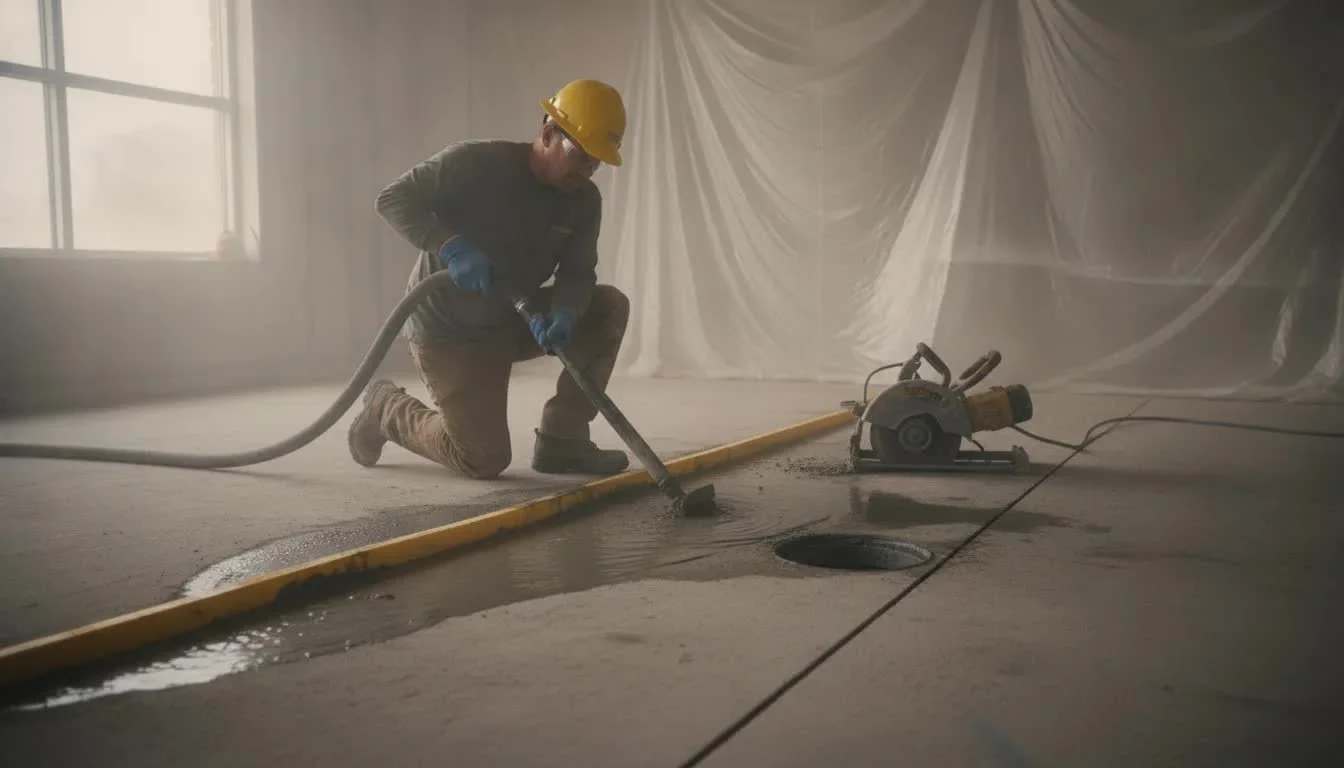
Concrete cutting slurry disposal is a planning job, not a mess to solve after the saw stops. Wet sawing and core drilling mix water with cement fines, aggregate, and debris. On an active Georgia renovation, that mix can reach drains, finished floors, or the next trade unless the team decides how it will be contained and moved.
Start with the cut layout and the site. Name who controls the work area, who supplies containment, and who removes what is collected. This guide covers the questions to answer before a Georgia cutting crew mobilizes. It does not replace a project waste plan or a local discharge approval.
What concrete cutting slurry is and why it needs a plan
Concrete cutting slurry is the wet residue from water used to cool a blade or core bit and to hold down dust. The mix changes with the concrete, the method, and how much water the crew uses. It can include cement paste, fine aggregate, chips, and water from the work area.
It is not clean rinse water, and it is not ordinary stormwater. The team needs a place for the liquid and the solids before cutting starts. A written handoff is easier than pushing wet material out of a building at the end of the day.
The U.S. Environmental Protection Agency concrete washout guide explains why cementitious water needs care. It can be caustic, it can affect soil and surface water, and it should stay in leak-proof containment. That guide is about washout, but the same idea applies to wet cutting residue. Do not send it to the nearest drain.
Start with the source, volume, and path
A useful plan starts with one site question. Where will the slurry be made, and where can it be captured? The answer changes from one job to the next.
Name the method. A short outdoor slab cut, a long wall-saw run, and a row of deep cores do not make the same residue.
Estimate the sequence. Several cuts in a row can fill a small tank even when each cut looks small.
Map the travel path. Note doors, elevators, stairs, finished floors, occupied rooms, and every hose route.
Mark drains and inlets. Include floor drains, trench drains, roof drains, storm inlets, and low spots.
Check the receiving spot. It needs capacity, a stable base, traffic protection, and a clear way out.
Put these details in the pre-cut talk, not only in a day-of fix. The Georgia concrete cutting planning guide is a related checklist for the outcome, access, utilities, and handoff. Photos, a marked plan, the slab thickness, and the opening sizes help the cutting contractor see the job before quoting.
Build containment before the first cut
Containment is the physical system that keeps slurry where the team expects it. The setup changes with the room and the scale. The questions stay the same.
Protect the work zone and nearby finishes
Use the berms, sheeting, pans, wet vacuums, drain covers, or tanks the site has approved. Protect finished floors, walls, equipment, and occupied paths from splash and tracking. A barrier that looks fine when it is dry can fail once water moves around a saw or a core barrel.
On an interior renovation, plan the path from the cut to the collection point. The crew may need a hose route, a temporary threshold, floor protection, or a spotter while containers move. The goal is not only to catch water at the blade. It is to stop fines from spreading after they leave the cut.
Keep capacity ahead of production
Size the setup for the planned sequence, plus extra water from rinsing, rain, or a pause. If the tank fills mid-cut, the crew may have to stop in a bad spot. The general contractor should know who watches capacity and who can stop the sequence.
Keep slurry separate from clean water
Do not use one container for every liquid on the job. Separate setup water, collected slurry, and solid debris when the site allows it. That split makes measurement and transport clearer. The cutting crew and the project's waste lead should pick the method for that site.
Compare containment choices before you mobilize
Pick the control that matches the cut, then write down what someone must confirm before water is turned on. These are planning checks, not a promise that one method fits every Georgia job.
Berm and floor protection. This fits a small interior cut when the crew can keep water inside one bay. Confirm that someone can vacuum as the saw moves and that nearby finishes stay covered.
Wet vacuum at the blade. This fits a core or a short saw cut with a person on the hose. Confirm that the tank has room for the whole sequence before the first cut.
Collection tank or pan. This fits a longer run that needs more holding capacity than a vacuum. Confirm a stable spot, a clear haul path, and a named person to empty it.
Drain covers and inlet protection. This fits any cut near a floor drain or a storm inlet. Confirm the covers stay in place until the responsible person clears the area.
Separate waste handoff. This fits when collection is in the cutting scope but hauling is not. Confirm who pumps, hauls, or disposes of the material, and what paperwork they need.
Read each row as its own statement. If the cut moves, walk the new path and update the same checks before water is turned on.
Decide who owns each disposal handoff
"The contractor will clean up" is not a slurry scope. Several parties may share the work. Write the split down before anyone mobilizes.
The cutting contractor should confirm water control, local collection, wet vacuuming, tool cleanup, and protection during the cut.
The general contractor or site manager should confirm access, drain covers, approved routes, and the next trade.
A waste or environmental contractor should confirm any pumping, transport, treatment, or receiving step, plus the paperwork that step needs.
The owner or facility lead should confirm building rules, work hours, sensitive rooms, and house discharge limits.
The compliance lead should confirm which stormwater plan, site rule, or local approval applies.
Cutting the opening does not automatically include off-site disposal. Ask for the boundary in writing. The work order should say whether it covers collection only, removal from the room, containers, transport, disposal, final washdown, or work by another trade.
Put Georgia compliance questions in the preconstruction plan
Georgia jobs can differ by site type, receiving water, permit, city, and owner rules. Do not copy one job's method onto the next job.
If the site has a construction stormwater authorization, review the plan with the person who owns it. The Georgia Environmental Protection Division stormwater forms page is where construction stormwater permits and related forms are listed. It is not project-specific advice. It does show why discharge planning belongs with the site's environmental controls, not with an improvised drain at the saw.
Ask these questions before work:
Does the site have a stormwater pollution prevention plan or a similar control plan?
Can any liquid go to a sanitary sewer, a storm drain, or soil, or is that closed?
Does the owner, city, utility, or waste handler need approval first?
Who can approve transport, treatment, recycling, or disposal?
What changes if rain, a blocked route, or a full tank breaks the sequence?
Never treat a nearby drain as an outlet. Follow the approved plan and the direction of the authority or the environmental professional on the job. If the answer is unclear, stop and get that person involved before any release.
Ask how slurry controls fit the cutting method
Slurry control works better when it matches the tool and the layout. These questions make a quote and a pre-task meeting more useful.
What cutting or drilling method is planned, and where does the water enter?
How will the crew catch water at the blade or the core bit?
What happens at a joint, an opening, a slope, or a change in floor height?
How will finished surfaces, occupied rooms, and building systems stay protected?
Who watches the vacuum or tank while the saw or drill is running?
How will a full container move without crossing bare finishes?
What does the crew need to know about thickness, steel, access, and work hours?
Does removal, hauling, or disposal sit with a different party?
Utility and steel information belong in the same talk. Review the scan before a cut or a core. The GPR scanning before concrete cutting checklist lists what to clarify first. If the opening moves, the water path and the collection point may move with it. Update the slurry plan when the cut plan changes.
Coordinate wet cutting with GPR, coring, and removal
Slurry disposal is one part of a cutting sequence. The job may also include scanning, coring, sawing, breaking, lifting, and hauling. A clean handoff keeps the disposal plan tied to the real work.
For a penetration, say whether the scope is scanning and layout, core drilling, residue collection, core removal, or some mix of those. The Georgia concrete core drilling guide helps a team frame access, material, and the opening. For a wider drilling scope, compare the request with the concrete drilling services guide before you lock the sequence. The Core Drilling and GPR Scanning page is the service page for openings through concrete, CMU, and masonry, and it is separate from this disposal plan.
Also name what happens after the cut. A cutting contractor may move a core or a saw-cut piece out of the immediate area. Another contractor may haul, patch, waterproof, or restore the finish. Do not hide those scopes inside the word cleanup. Put each handoff on the schedule and name who makes the area ready for the next trade.
Plan collection, transport, and final cleanup apart
Catching slurry at the cut is the first control. It is not final disposal. Before work starts, know whether material stays in an approved container, moves to another container, goes through an approved treatment step, or goes to a facility that accepts it.
Keep liquid and solids from escaping while they move. Use containers that fit the material, stay stable, and follow the project's labeling rules. Letting slurry dry on a floor, in soil, or in an open pan does not end the problem. Hardened residue still has to come up without wrecking finishes or entering a drain. The recycling or disposal call belongs to the project's waste lead.
If the project allows recycling, write down the destination and what that facility accepts. The concrete recycling and sustainable demolition guide is broader context for separating concrete materials. Acceptance rules are site-specific. Do not promise that every wet stream can be recycled.
Final cleanup should include a look at the cut zone, the route, nearby drains, staging, and any finish that took a splash. The project manager decides what proof is needed, such as photos, container notes, a pickup receipt, or a sign-off from the next trade.
Use a simple Georgia jobsite timeline
Before the meeting, gather locations, sizes, thickness, access notes, work hours, drains, site rules, and any scan or drawing. Name the person who decides discharge and waste questions. If the work is indoors, walk the route from the cut to the tank.
In the meeting, review the method, water source, containment, capacity, the route, and the stop conditions. Confirm who supplies each item and who removes what is collected. The crew, the general contractor, the facility, and the next trade should share one boundary.
On the day of the cut, inspect containment before the water is on. Cover or isolate drains, stage the vacuum or tank, and confirm the opening has not moved. Watch the system during the work. If the site does not match the plan, pause instead of sending slurry somewhere new.
After the cut, finish the handoff, clear residue from the zone, check the route and the drains, and record the agreed pickup or disposal note. If another trade will patch or finish, say what surface they will find and what is still open.
What to include in a concrete cutting quote request
A clear request helps the cutting contractor price the work and helps the general contractor see the exclusions. Include these items:
The Georgia city or job location, and the type of building.
Whether the work is interior, exterior, occupied, or inside an active renovation.
The number, size, depth, and rough location of each cut or core.
Thickness, known steel, post-tension notes, and any drawings on hand.
Access limits, floor protection, elevators, stairs, loading, and work hours.
Nearby drains, sensitive finishes, weather, and the proposed collection area.
Whether scanning, layout, core removal, saw-cut removal, or demolition is requested.
Who supplies containers, wet vacuums, pumping, hauling, or disposal coordination.
Which cleanup and next-trade handoffs are in the scope, and which are out.
Any owner, stormwater, or facility rule already identified.
Compare proposals on those details, not only on the bottom line. The guide to concrete cutting quotes explains why scope boundaries and site assumptions matter when you read bids. A missing slurry line is a scope gap, not a discount.
When to plan concrete cutting slurry disposal with a contractor
Call the cutting contractor before the schedule is locked. Do that when the work is indoors, near occupied space, or beside sensitive finishes. The same is true for a large mechanical install or a narrow access route. Early review leaves time for scanning, cutting, collection, removal, and the next handoff.
All Pro Demolition provides demolition, concrete cutting, core drilling, and GPR scanning. Our team can talk through the cutting and scanning scope for a Georgia job. The concrete cutting guidance adds questions for comparing contractors. Off-site slurry handling stays with the owner, the general contractor, or the environmental professional named for that site. We do not treat disposal as an All Pro service.
Call (470) 345-2816 to plan the cutting and scanning scope before slurry controls are set.
Frequently asked questions about concrete cutting slurry disposal
Can concrete cutting slurry go down a storm drain?
Do not assume it can. A storm inlet is not a default route for cementitious water or solids. Follow the approved controls and the direction of the authority or environmental professional on the job. Hold the material until that person confirms the next step.
Is slurry disposal included in a concrete cutting quote?
It may or may not be. Ask whether the quote includes capture at the cut, wet vacuuming, containers, movement out of the room, transport, disposal, and final cleanup. Get every exclusion in writing.
Does GPR scanning solve the slurry problem?
No. A scan helps the team see embedded conditions and place the opening. It does not replace containment, drain protection, collection, or a disposal plan. Coordinate the scan and the slurry plan before work starts.
Who is responsible for disposal on a renovation site?
That depends on the contract and the site's waste rules. The cutting contractor, the general contractor, the owner, or a separate waste firm may each own a piece. Assign those pieces before mobilization, and name who can approve a change.
What should I do if the planned container fills early?
Pause safely, protect the area from overflow, and call the person assigned to collection. Do not send slurry to a drain, to soil, or to a spot nobody approved. Update the capacity plan before you restart.
